Quick Summary
An RFID warehouse management system replaces manual entries in plant stores with automatic tag reads at receiving, storage, issue, and exit. This guide explains how it works in manufacturing plants, where it outperforms barcodes, where it struggles, how to implement it with SAP or other ERPs, and what to look for when choosing one.
Introduction
A furnace trips at 2 a.m. The maintenance team needs a specific bearing. The ERP shows four in stock. The store has none, because two were issued last month without a slip and two were moved to another bay during a stock rearrangement nobody recorded.
This is the everyday reality of many plant stores. The problem is rarely that the ERP is wrong in design. It is that the link between physical movement and the system record depends on someone writing a slip, scanning a barcode, or keying a GRN. In a busy shift, those steps get skipped, delayed, or done from memory.
An RFID warehouse management system removes much of that dependency. Tags on items, bins and pallets are read automatically as material moves, so the record is created by the movement itself. For steel, cement, mining and power plants, where spare parts inventory management directly affects equipment uptime, that difference matters more than it does in a typical retail warehouse.
This guide covers how the technology works, why plant stores need a different approach, the practical benefits and limits, and how to implement it without disrupting operations.
What Is an RFID Warehouse Management System?
It is warehouse software that uses radio frequency identification as its main data capture method. Instead of a storekeeper scanning each item, readers detect tags within range and log the event with time, location, and item identity. Most industrial deployments use passive UHF tags, which need no battery and can be read from a distance.
Core components
- Tags on items, bins, pallets or crates. Metal items need on-metal tags; standard labels fail on steel surfaces.
- Fixed readers and RFID portal gates at store entry, exit and inter-bay points to capture movement automatically.
- Handheld readers for cycle counts, bin audits and searches.
- Middleware that filters raw reads, removes duplicates and decides whether a read represents real movement.
- WMS software that holds stock, bin locations and transactions, and syncs with the ERP.
How material flows through it
- Material arrives and is tagged or matched to an existing tag at receiving.
- The GRN is created against the purchase order.
- Put-away links the tag to a bin location.
- An issue request reserves the item, and the portal gate confirms it actually left.
- Transfers and returns are recorded the same way.
The result is an RFID inventory management system where each stock change is tied to a physical event, not a manual entry.
Why Manufacturing Plant Stores Need a Different Approach
Most warehouse software is designed for distribution centres: fast-moving cartons, uniform SKUs and predictable pick paths. A plant store looks very different, and an industrial warehouse management system has to handle that.
The item mix is wide and uneven. A single store may hold motor spares, refractory bricks, gaskets, cables, lubricants, safety gear and consumables. Many items are slow-moving but critical. A pump seal that moves twice a year can halt a production line if it is missing.
The physical conditions are harder too. Dust, heat, vibration and steel racking affect tags and readers. Items are often large, irregular or heavy, so tagging must be durable and placed where readers can see it.
Accountability is also different. Material is issued against work orders and cost centres, returned partly used, or moved between stores. Good MRO inventory management depends on knowing who took what, for which job, and whether it came back.
Finally, the ERP is the system of record. Plants running SAP or Oracle do not want a parallel inventory. The WMS must post GRNs, issues and transfers back to the ERP without double entry.
Benefits, Limits and How RFID Compares with Barcodes
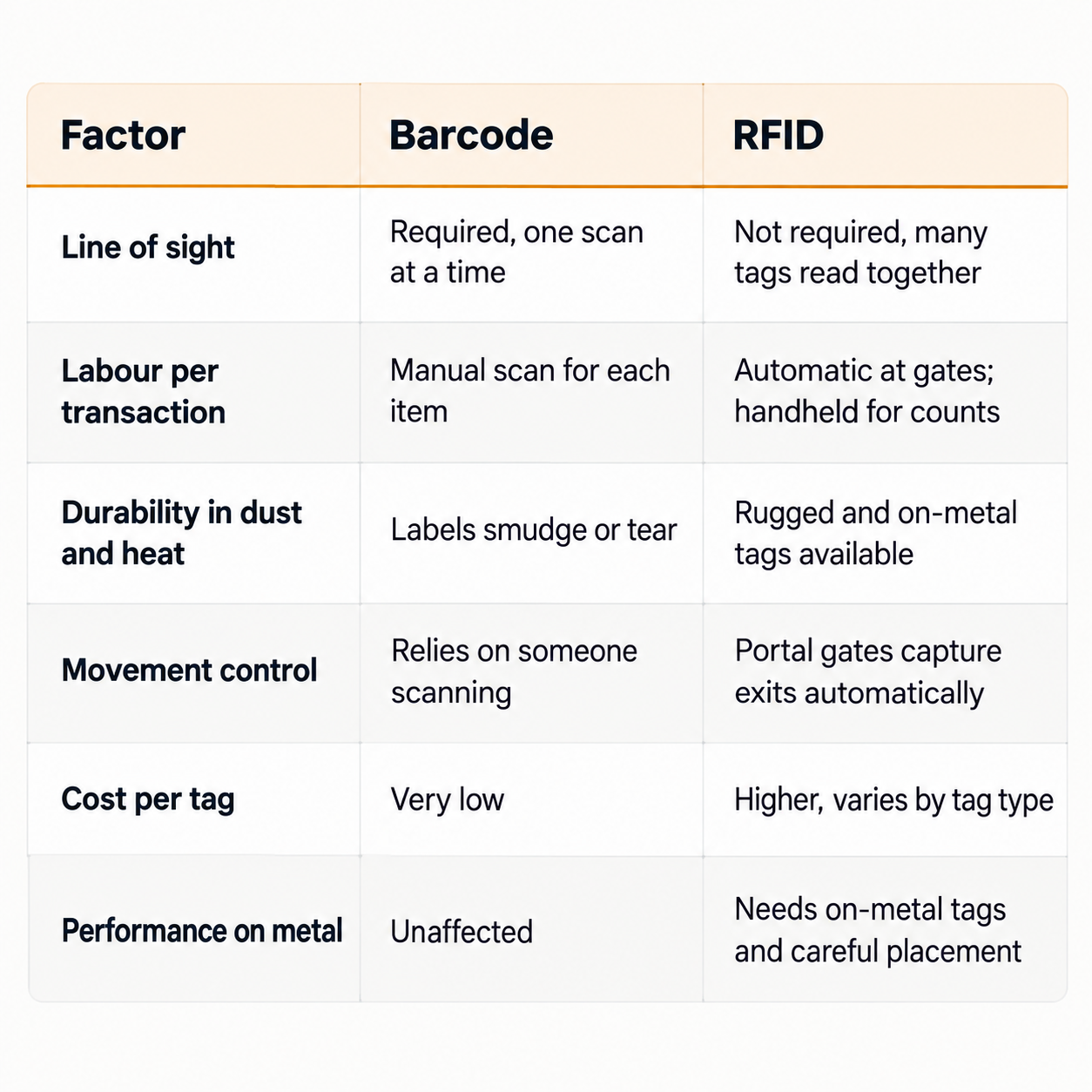
The main benefit is that stock records stop depending on memory and discipline. Movements are captured as they happen, which gives real-time inventory visibility and makes discrepancies visible within the shift rather than at the year-end audit. Cycle counts that once took days with a ledger can be done bin by bin with a handheld reader. Portal gates add a control point, so material cannot leave the store without a matching transaction.
RFID is not a perfect fix, though. Metal, liquids and dense packing reduce read reliability. Portal gates can record nearby tags that never moved (ghost reads) or miss tags that did (missed reads), so read zones and filtering logic must be designed carefully. Tags cost more than barcode labels, and very small items may not be practical to tag individually. Bin-level or kit-level tagging is often the better choice there.
How to Implement RFID in a Plant Store
Most failed rollouts skip the groundwork and go straight to buying readers. A phased approach works better.
- Clean the master data first. Duplicate material codes, wrong units and missing bin locations in the ERP will be copied straight into the new system.
- Decide what to tag. Start with critical spares and high-value items. Choose tag types after testing them on your actual parts, not on a demo sample.
- Survey the store. Map metal racking, entry points and staging areas before fixing gate and antenna positions.
- Pilot one store or bay. Measure read reliability, gate exceptions and user adoption before extending.
- Integrate with the ERP. Define which transactions post automatically and which need approval.
- Train the store team. The system changes their role from data entry to exception handling, and that shift needs support.
ERP integration
This is usually the deciding factor. A SAP-integrated warehouse management system should exchange GRNs, material reservations, issues and stock transfers with the ERP in near real time. Ask vendors how failures are handled when the ERP is offline, and whether postings queue and retry.
Where AI fits
An AI warehouse management system adds analysis on top of RFID data. Typical uses include flagging unusual issue patterns, detecting reads that do not match expected movement, and using cameras to count or verify items that RFID alone cannot confirm. Treat it as a second layer of evidence, not a replacement for clean processes.
For teams evaluating a warehouse management system in India, check local support availability, on-site installation capability and experience with Indian ERP configurations as closely as the software features.
How Helious Smart Store Brings RFID Control to Plant Stores
Helious Tech Solutions built Smart Store for the conditions described above: steel, cement, mining and power plant stores handling spares, MRO items and consumables. It combines RFID with AI and connects to the ERP, and it can run on its own or as an extended module of TAT Guard, which covers truck logistics from plant gate to dispatch. All six capabilities below come as part of the product.
- RFID-Based Identification and Traceability. Tagged materials and spares are tracked across receiving, storage, transfers and issuing. This cuts manual scanning errors and helps teams find critical items quickly during breakdowns.
- Real-Time Inventory Visibility. A central dashboard shows material availability, bin locations and stock movements, so misplaced items and inaccurate records are caught before they delay maintenance.
- Secure Material Movement with RFID Portal Gates. Entry and exit gates check tagged items against authorised transactions, record each movement and alert the team to mismatches. This closes the gap where stock leaves without a slip.
- Automated Inventory Reconciliation. Captured data is compared against system records and discrepancies are highlighted, which reduces manual counting and speeds up stock audits.
- SAP and ERP Integration. GRNs, material reservations, stock transfers and issues are exchanged with SAP and compatible ERPs, removing duplicate entry between the store and the system of record.
- Automated GRN and Gate-In/Gate-Out Management. Incoming material details are captured at receipt, GRN processing is automated, and outbound movements are validated against authorised records, giving traceability from receiving to dispatch.
For material that moves outside the store, Smart Store works alongside Helious Smart Material Tracking and AI-powered bag counting. Full details are on the Smart Store product page.
Conclusion
An RFID warehouse management system earns its place in a manufacturing plant by making the stock record follow physical movement automatically. Its value is highest where stockouts of critical spares are expensive, where material leaves the store without proper records, and where audits keep revealing the same gaps.
It is not a plug-and-play fix. Tag selection, gate design, master data and ERP integration decide whether it works. Plants that start with a focused pilot, test on their own materials and integrate tightly with the ERP will get a store record the maintenance team can actually rely on.