Quick Summary
Barcode-based warehouse management software assumes someone will scan every movement, and plant stores rarely work that way. This article explains where barcode-era WMS breaks down in MRO and spares stores, how RFID warehouse management captures movement without depending on a scan, what RFID cannot do, and how to integrate it with SAP without creating a second, conflicting stock record.

Introduction
A maintenance crew needs a replacement bearing for a conveyor gearbox at 2 a.m. The storekeeper hands it over and notes the material code on a slip to scan in the morning. Until that scan happens, SAP shows the bearing as available, and MRP has no reason to reorder it.
Nothing here is unusual. It is how many plant stores in steel, cement, power, and mining run, and it is the gap barcode-era WMS was never designed to close. Barcodes record what someone chose to scan, not what physically moved.
That explains a familiar pattern: the plant runs SAP and a barcode WMS, yet every physical verification still finds book stock and bin stock disagreeing. SAP-integrated RFID warehouse management attacks the capture problem directly: readers detect the movement, and the system matches it to an SAP document.
Why Barcode-Era Warehouse Management Software Breaks on the Shop Floor

Barcode WMS and most warehouse automation software were designed for distribution warehouses: packaged goods, clean labels, planned picks, and dedicated scanning staff. A plant store has almost none of those.
The Scan Depends on Discipline, Not Physics
Every barcode transaction needs a person, a handheld, a readable label, and a spare minute. During a breakdown or shift change, the storekeeper holding the part also has an engineer waiting. The scan gets skipped, and the system cannot know it.
Labels Don't Survive Plant Conditions
Printed labels on greasy gearbox housings, heat-exposed parts, or items stored outdoors smudge, peel, or get scraped off. Workarounds follow, most commonly a laminated barcode sheet at the counter, which confirms a code was selected, not that the item was present.
Stock Moves Without a Transaction
Items get shifted between bins, borrowed for a trial fit, or carried out as returnable without a reconciled gate pass. A barcode system sees only reported movements, so bins drift and pickers search racks the system insists hold the part.
SAP is Updated Late
Many barcode deployments post to SAP in batches, through end-of-shift uploads or middleware jobs that fail quietly. Meanwhile, SAP shows stock that has already left, reservations are confirmed against missing material, and MRP stays silent on critical spares.
Counting is Too Slow to Catch Drift
Item-by-item scanning makes full counts expensive, so plants defer them to the annual physical verification. By then, differences have piled up, and write-offs replace root-cause analysis.
How RFID Warehouse Management Changes the Capture Model
RFID warehouse management moves the source of truth from the scan to the movement. Passive UHF tags (EPC Gen2, operating in India's 865–867 MHz band) are read by radio, not sight. One reader pass identifies many tags through packaging, without the tag facing the antenna.
That changes three things in a plant store.
Movement is captured without a button press. Fixed readers at store doors and issue counters act as portals. When a tagged item passes, the warehouse inventory software records the event and checks it against an open issue document. An unmatched movement becomes an immediate exception, not a surprise at the next verification.
Counting becomes routine. A storekeeper with a handheld reader sweeps an aisle and captures every tag in range, so counts on critical spares can run weekly instead of annually.
Bin locations stay honest. Each sweep also confirms where every tag was read, correcting drift as it happens.
This is also what makes an AI-powered warehouse credible. Anomaly detection and consumption forecasting need complete movement data; analytics on barcode data that miss night-shift issues automate the error.
Barcode vs RFID in a Plant Store: What Each Can and Cannot Do
Neither technology wins everywhere. The choice depends on the material, its value, and whether movement must be controlled or just recorded.
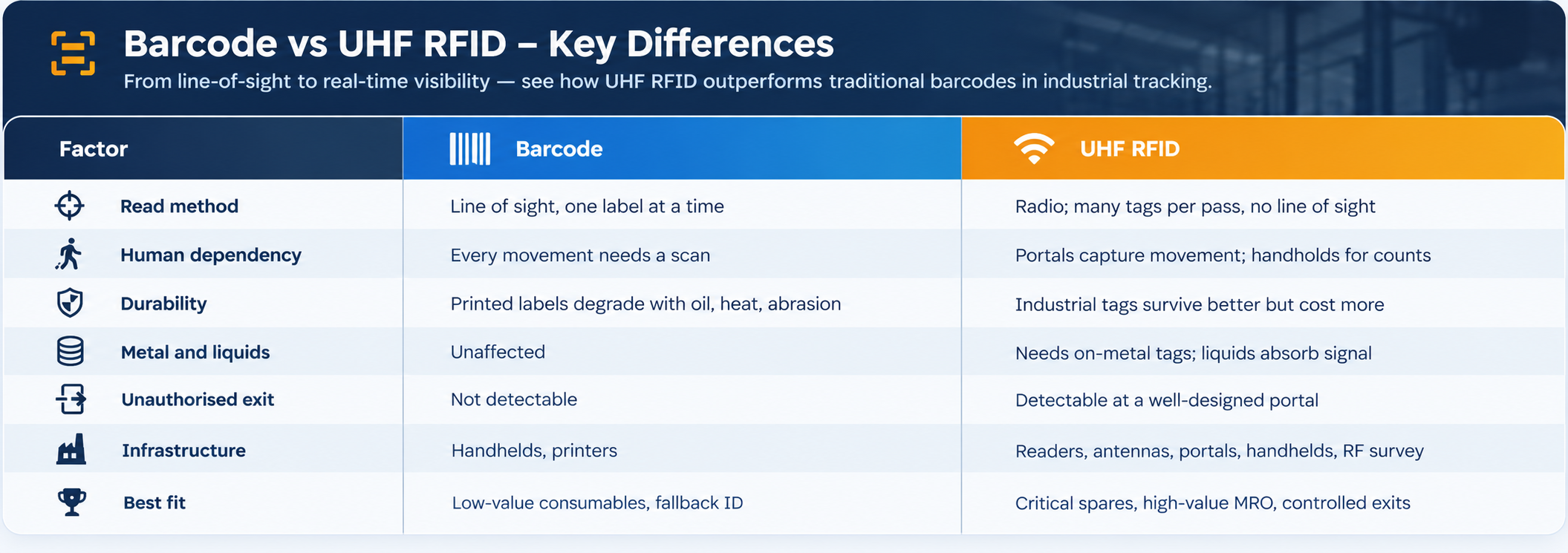
Where RFID Falls Short
RFID confirms a tag was read, not what is inside the box or whether the part is serviceable. A carton of gaskets with one tag reads as one carton; loose bolts and washers are tagged at bin or packet level.
Adjacent bins can produce stray reads if antenna power and placement aren't tuned, and a tag that was cut off or never applied is invisible. RFID reduces dependence on human discipline; it doesn't remove it.
Most plants therefore use hybrid labels: an RFID inlay, printed barcode, and human-readable material code on one label, so a failed tag still has a fallback.
Getting the SAP Integration Right
The most common mistake in SAP-integrated RFID is treating a tag read as a goods movement. A read is an event. SAP needs a document.
Map Every Event to a Movement Type
Each capture must resolve to a posting SAP understands: goods receipt against a purchase order (movement type 101), goods issue to a maintenance or production order (261) or cost centre (201), or a storage-location transfer (311). The WMS picks the right one by matching the read to an open PO, reservation, or transfer request. Unmatched reads go to an exception queue, not SAP.
Decide What Each System Owns
SAP stays the system of record for quantity and valuation at storage-location level. Many plants run SAP Inventory Management without EWM for MRO stores, where the bin is just a descriptive field. The RFID layer should own bin locations and tag identity, never a parallel stock balance.
Map Tags to Materials Cleanly
A tag identifies one physical piece; an SAP material number identifies a type of item. That mapping, including serial numbers for rotables, needs a controlled home. Clean duplicate MRO material codes first, or they become duplicate mappings.
Post in Near Real Time, with Visible Failures
Use standard interfaces such as BAPI_GOODSMVT_CREATE, IDocs or S/4HANA's released APIs, and post as events occur. When postings fail on a closed period, blocked stock, or a missing reservation, they need a visible retry queue with an owner. Otherwise, barcode-era drift returns with better hardware.
What Decides Whether a Smart Store Rollout Works

A smart store project is a data and process project first, hardware second.
- Clean master data before tagging. Merge duplicate material codes, verify physical stock, and fix bins. Tagging dirty data locks the errors in.
- Tag by criticality. Start with vital and high-value spares using your VED or ABC classification, then extend to consumables where the economics justify it.
- Survey the RF environment. Metal racking, door widths, forklift paths, and bin spacing decide antenna placement and portal design.
- Design the emergency path. Breakdown issues will bypass the normal flow. Allow them, record them at the portal, and require a document within the shift.
- Run one store in parallel. Compare RFID counts with SAP for a full cycle before rolling out further.
How Helious Smart Store Handles RFID and SAP in Plant Stores
Helious Smart Store is an RFID-based warehouse management system for plant stores in steel, cement, mining, and power, where MRO and spares discipline directly affects equipment uptime. It deploys standalone or as an extension of TAT Guard, alongside gate access control and the AI-unmanned weighbridge, so material can be followed from gate-in to shelf to issue.
- RFID-based identification and traceability. Every tagged spare, consumable, and MRO item carries its own identity, so movement history is recorded, not inferred from scans.
- Real-time, bin-level inventory visibility. Live location of stock across bins and storage locations addresses the bin drift barcode systems accumulate.
- RFID portal gates. Automated gates control and authenticate movement in and out of the store, flagging unauthorised transfers.
- Automated inventory reconciliation. Handheld sweeps are reconciled against system records automatically, so differences surface when they occur., so differences surface when they occur.
- Real-time ERP integration. Direct integration with SAP, Oracle and legacy ERPs posts GRNs, material issues and stock transfers as they occur, not through overnight batches, with failed postings surfaced for action.
- Multi-store scale. Several stores across a plant or group run under one warehouse management system.
For material moving through production, Smart Material Tracking extends the same visibility on the Helious Platform.
Conclusion
Barcode-era WMS fails in plant stores because it records scans, and plant stores move material faster than people scan it. More handhelds and stricter SOPs narrow the gap but don't close it.
SAP-integrated RFID closes most of it by detecting movement at the portal and in the bin, then posting a matched document to SAP. Hardware alone won't deliver that; clean master data, a clear SAP-versus-RFID ownership split, and a visible failure queue decide whether the investment pays back. Start with critical spares in one store and prove the numbers against SAP before scaling.