Quick Summary
An AI bag counting system for cement plant dispatch tells you how many bags went onto a truck. The weighbridge tells you how much mass left the gate. This guide explains how to reconcile the two before release: calculating expected weight, setting realistic tolerance bands, reading mismatches, and wiring the check into an unmanned weighbridge workflow.
Introduction
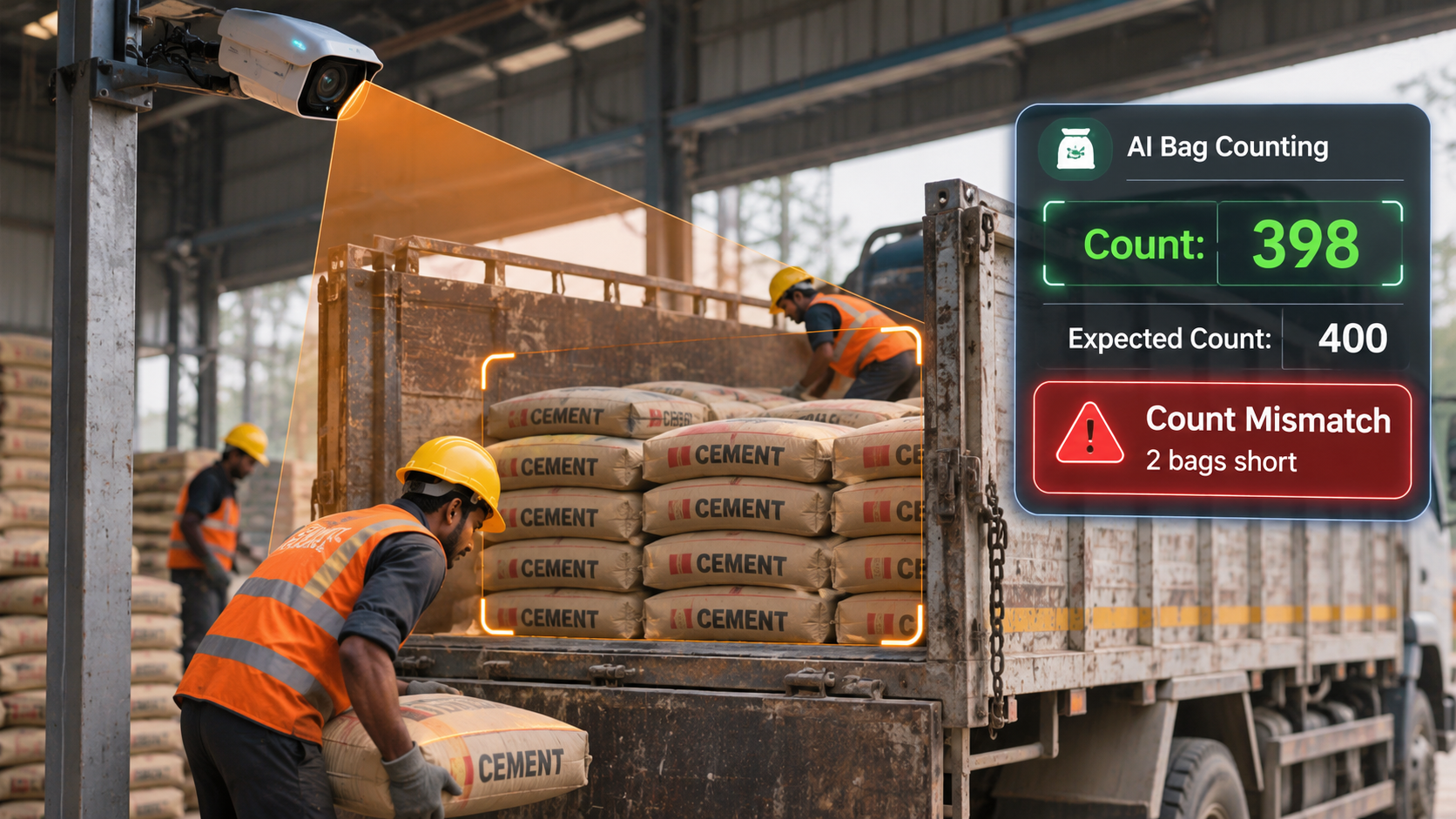
A truck at the outbound weighbridge shows a net weight 140 kg higher than the delivery order implies. The loader's count says 400 bags. Is that three extra bags, a heavy-filling packer, a tarpaulin added after tare, or a driver standing on the platform for one weighment only?
Most plants find out days later, when a dealer disputes the invoice or a stock audit comes up short.
The fix is a rule that compares both numbers while the truck is still on the platform. An AI bag counting system for cement plant dispatch and a weighbridge each measure something different, and each fails in different ways. Reconciliation works because those failure modes rarely overlap. When they disagree, the pattern usually points to the cause.
Why Bag Counts and Weighbridge Weight Disagree
Counting errors
A bag counting camera over a truck loader or conveyor can miss or double-count bags when bags slide through touching, bounce back across the counting line, or a loader restarts mid-truck. No counter sees bags that never pass through its field of view, such as bags hand-loaded from a side stack to complete an order.
Bag weight variation
A 50 kg cement bag is rarely exactly 50 kg. Packer spouts drift, and a packer running slightly heavy adds up across 400 bags. Torn bags lose material between the packer and the truck. None of this changes the count, but all of it changes the weight.
Tare problems
Net weight is only as good as the tare. A stored tare from last month will not reflect a new spare wheel, a full diesel tank or a tarpaulin and ropes. A fresh tare can still be off if someone stands on the platform for one reading only.
Things that are not bags
Pallets, dunnage, loose spillage, or anything deliberately added to the truck will show up on the scale and never on the count.
How the Reconciliation Check Works
Expected net weight = AI bag count × calibrated average bag weight + declared non-bag items
Variance = weighbridge net weight − expected net weight
Bag-equivalent variance = variance ÷ calibrated average bag weight
First, use a calibrated bag weight, not the printed 50 kg. Take it from your packer check-weigher data or regular sample weighing, and update it per packer line or per shift if filling drifts. Otherwise, a heavy-running packer builds a permanent variance into every truck, and operators learn to ignore alerts.
Second, express variance in bags, not just kilograms. “+2.8 bags” prompts the right question faster than “+140 kg”.
An illustrative example (figures for explanation, not plant data):
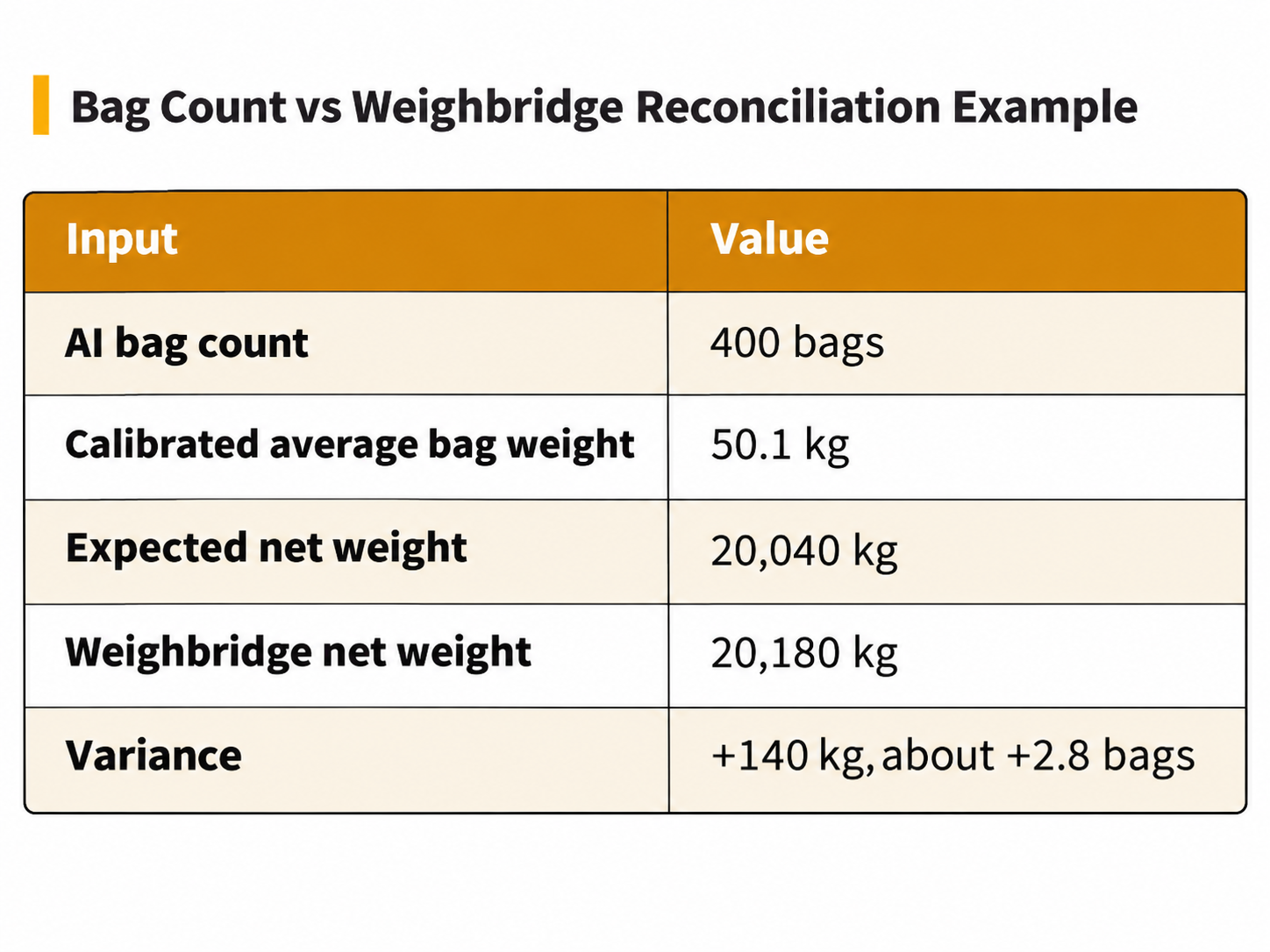
Whether +2.8 bags is a problem depends on the tolerance band.
Setting Tolerance Bands That Hold Up in a Real Plant
Here is the uncomfortable part: on a fully loaded truck, a single missing bag can sit inside normal weight noise. The weighbridge's scale interval, random bag-to-bag variation and small tare errors together can add up to more than one bag's weight. Reconciliation reliably catches multi-bag gaps, packer drift and tare manipulation, not single-bag errors. The count must stay the primary record; weight is the independent check.
A workable band accounts for:
- Weighbridge resolution: the scale interval of your bridge, plus any known drift between calibrations.
- Random bag variation: spreads out as bag numbers grow, but more slowly than the load itself.
- Systematic packer bias: grows in direct proportion to the bag count, which is why calibration matters.
- Tare uncertainty: lower with a fresh tare on every trip, higher with stored tares.
The practical route is to run the check in shadow mode for a few weeks. Log the variance on every truck without blocking any, and investigate the outliers. The spread of variance on trucks you have confirmed as correct becomes your band.
Use three zones: green for automatic release, amber for supervisor review against video, and red for a hold and recount. Set them per product and bag size, because a 25 kg bag and a 50 kg bag need different thresholds.
A Pre-Dispatch Reconciliation Workflow
The check only works if the count, the weights and the delivery order all belong to the same truck. With weighbridge automation, that linkage is built into the sequence.
- Gate entry and identification. The truck is identified by RFID tag or ANPR and matched to an open delivery order.
- Tare weighment. An unmanned weighbridge system captures a fresh tare, checks vehicle positioning on the platform, and records camera images.
- Loading with live count. At the loading bay, the bag counting camera counts bags against the order quantity. A count mismatch is flagged here, before the truck ever reaches the outbound bridge.
- Gross weighment. The same truck is identified again, positioned, and weighed.
- Reconciliation. Expected and actual net weights are compared, and the bag-equivalent variance is checked against the band for that product.
- Decision. Green releases the truck and posts dispatch quantities to ERP. Amber or red holds the boom barrier and sends an alert with the count video and weighment images attached.
Catching an under-count at the loader is far cheaper than catching it at the gate, where the truck has to back out of the queue.
Reading a Mismatch: What the Pattern Tells You
A mismatch is a clue, not a verdict. Its direction usually narrows the cause.
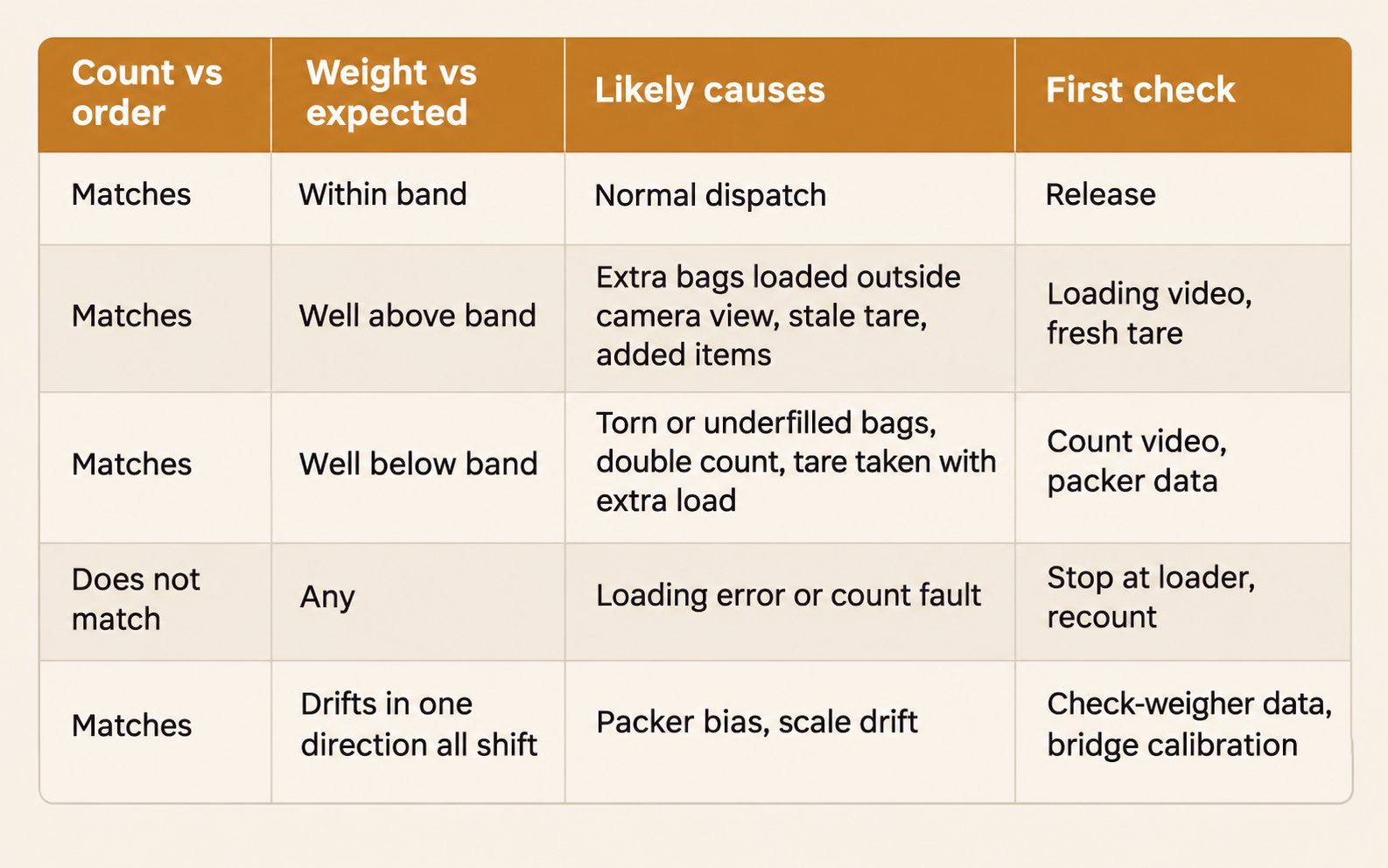
If many trucks in a row lean the same way, the problem is your calibrated bag weight or your weighbridge, not any one truck.
Integration and Limits Worth Knowing Upfront
The hardest engineering problem is not counting or weighing. It is binding the right count to the right truck. With adjacent loading bays or split loading sessions, every count must attach to one vehicle ID and one delivery order. Settle this with the vendor before go-live.
Other points to plan for:
- ERP posting: decide whether ERP receives the count, the weight, or both, and which one drives the invoice.
- Connectivity: counting and weighing should keep working during network outages and sync afterwards.
- What neither system sees: the wrong cement grade in the right bag, or a slightly underfilled bag that still sits inside the weight band. Those need packing-line controls.
How Helious Bag Counting and Weighbridge Automation Support Reconciliation
Reconciliation needs two trustworthy data sources tied to one truck. Helious Tech Solutions covers each side and feeds both into the plant's ERP.
From the Helious AI Bag Counting System, a computer vision bag counting solution built for cement, fertiliser and similar dispatch lines:
- Per-bag object tracking: each bag is tracked individually and counted at a virtual line, including overlapping or torn bags.
- Timestamped video audit trail: amber or red results can be reviewed against footage of the actual loading.
- Real-time deviation alerts: supervisors are notified when a count departs from the order target.
- Edge processing: counting continues during network outages.
- Infrared-capable cameras: for consistent night-shift counting.
- ERP and WMS integration: Compatible with any existing ERP systems.
From the unmanned weighbridge system under TAT Guard (in-plant logistics solution):
- RFID and ANPR vehicle identification: links the weighments to the same truck that was loaded.
- AI vision cameras: confirm the truck sits correctly on the platform before a reading is accepted.
- Truck image capture: adds visual evidence to each weighment.
- Boom barriers, displays and voice guidance: hold or release the truck without an operator.
- Compatibility and ERP links: works with new or existing weighbridges of any make and integrates with any existing ERP systems.
The tolerance bands themselves should still be set from your own plant data during commissioning.
Conclusion
Reconciling AI bag counts with weighbridge weight works because the two measurements fail differently. Treat the count as the primary record, use weight as the independent check, and base the expected weight on a calibrated bag weight rather than the printed one. Build tolerance bands from your own trucks, catch count errors at the loader, and let the pattern of a mismatch point you to its cause. Done this way, most disputes get settled before the truck leaves the gate.