Quick Summary
An AI bag counting system uses cameras and computer vision to count cement bags as they move on loading conveyors into trucks and wagons. This buyer's guide explains how a camera based bag counting system works, where it fails, what to test before buying, and how to integrate counts with packer, weighbridge, and ERP records.
Introduction

A truck leaves the packing plant with an invoice for 400 bags. At the dealer's warehouse, the count comes to 396. The dealer raises a short-supply claim, the transporter blames the loading crew, and the plant has nothing better than a loader's tally sheet to defend itself.
Anyone in cement dispatch knows this argument. The loss per truck is small, but repeated across hundreds of vehicles a day it becomes a revenue leak, a dealer relationship problem, and an audit headache.
That is why plants are evaluating an AI bag counting system instead of manual tallies or sensor counters. The market is uneven, though. Some systems are a camera with a line-crossing script; others are built for the dust and bag overlap of a real loading bay.
This guide covers what the technology does, where it breaks, and what to test before you sign a purchase order.
Why Bag Counts Go Wrong in Cement Dispatch
Most counting errors are not caused by dishonesty. They come from the way loading actually works.
A rotary packer discharges bags onto a belt conveyor that feeds a truck or wagon loader. Somewhere on that path, a person or a sensor must count every bag. Several things get in the way:
- Fatigue. A loader counting for a full shift will lose track, especially after belt stoppages or interruptions.
- Burst and rejected bags. If torn bags are pulled off and the tally is not corrected, invoice and load disagree.
- Bags removed after counting. A count point placed too early cannot see bags taken off before the truck leaves.
- Shift-level reconciliation. Plants with several packers often reconcile per shift, not per vehicle, so disputes cannot be traced to a truck.
- No evidence. A tally sheet proves nothing when a dealer disputes a count.
Why basic sensors do not fully solve it
Photoelectric and proximity sensors work when bags arrive one at a time with a clear gap. They struggle when bags travel touching, sit skewed, or rock back and forth under the beam. Dust on the lens adds missed or extra triggers.
Sensors produce a number, but no image. When the number is questioned, there is nothing to review. That gap is the main reason plants move to a cement bag counting system built on computer vision.
How a Camera Based Bag Counting System Works
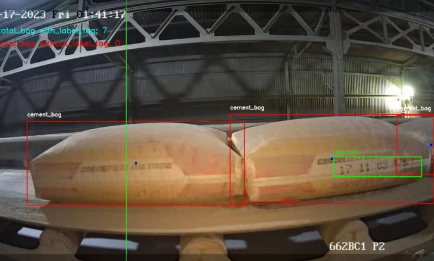
A camera based bag counting system replaces the "did something break the beam?" logic of a sensor with "is that object a bag, and has it crossed the count zone?" The difference matters in practice.
A typical setup works in five stages:
- Image capture. An industrial camera above the conveyor, usually near the loading end, records bags moving on the belt.
- Bag detection. A trained deep learning model identifies each bag in every frame. Because it recognises shape, not a light interruption, it can separate touching bags.
- Tracking. Each bag gets an identity and is followed across frames, so a bag that stops or jerks backward is not counted twice.
- Counting logic. A bag counts only when it crosses a defined zone in the correct direction.
- Vehicle linking. The count is tied to the truck or wagon through the delivery order, an RFID tag, or the vehicle number from the gate or weighbridge system.
Most systems also save video clips or snapshots against each loading session. That record is what turns a count into evidence.
Where the processing happens
Processing usually runs on an edge device near the loading bay, with only results sent to the server or ERP. Ask what happens if the network drops mid-loading. A sound system keeps counting locally and syncs later.
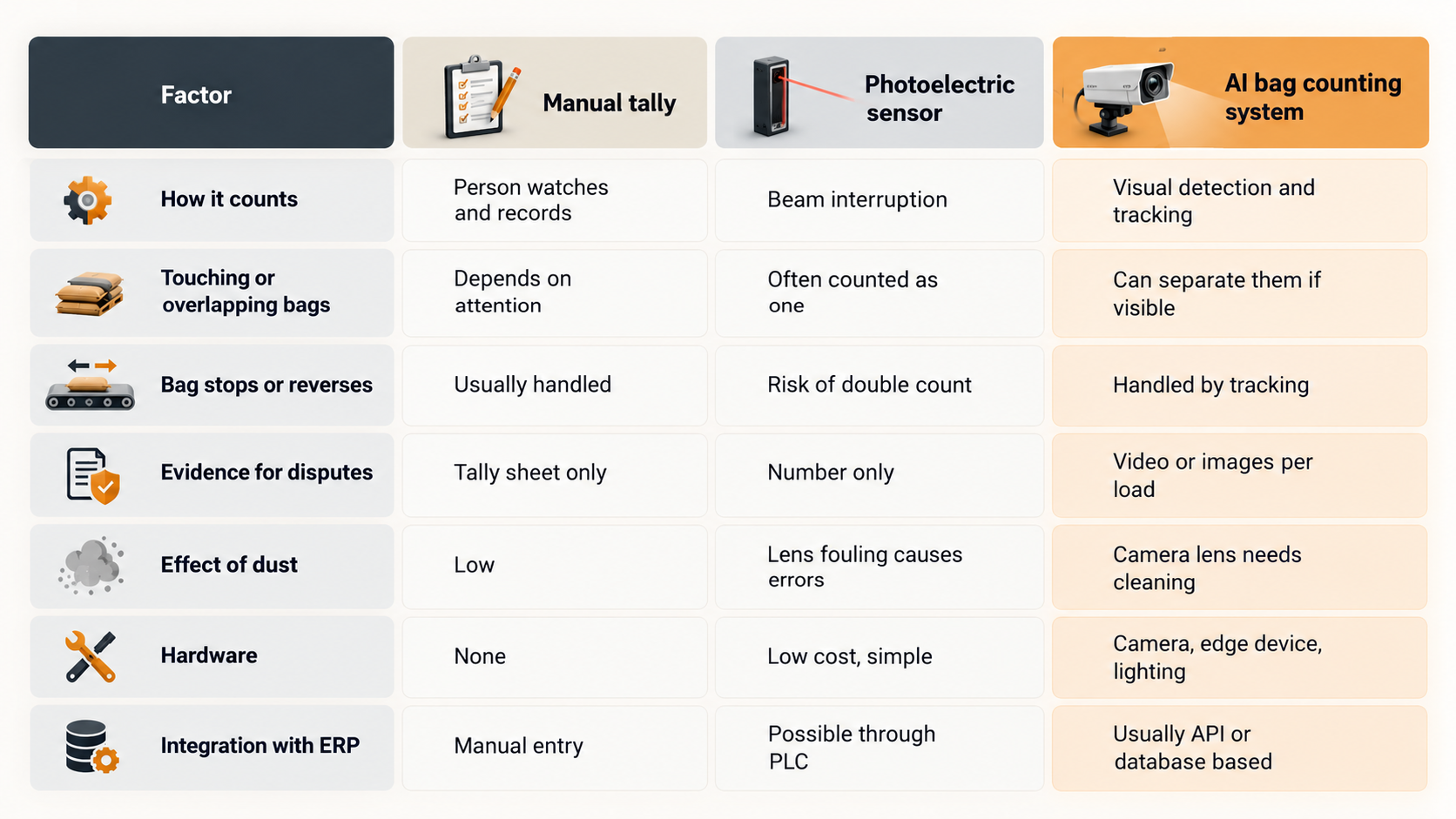
Manual vs Sensor vs AI Bag Counting: An Honest Comparison
No method is perfect. The right choice depends on loading speed, bag flow, and how often counts are disputed.
What an AI Bag Counting System Cannot Do
Computer vision has real limits, and a credible vendor will discuss them openly:
- It counts only what it can see. Bags hidden behind a guard or fully stacked over each other reduce accuracy.
- It does not weigh bags. Fill weight belongs to the packer's check-weigher and the weighbridge.
- It cannot see past the count zone. Bags removed inside the truck need weighbridge reconciliation or loading-area surveillance.
- Dust and lighting matter. Lens build-up and changing light degrade detection without planned cleaning.
- Models need site tuning. New bag colours, prints, or conveyor angles may require retraining.
What to Evaluate Before Buying an AI Bag Counting System
Brochure accuracy figures usually come from clean demo conditions. These six checks tell you whether a system will survive your plant.
1. Accuracy under your conditions, not theirs
Insist on a trial on your conveyor, with your bags, during normal shifts, including peak speed, belt stoppages, and touching bags. An accuracy claim without a site trial is a marketing number.
2. Handling of truck and wagon loading
Rake loading runs longer and often uses several loaders at once. Confirm counts are assigned to the correct wagon, not just the shift.
3. Evidence and audit trail
Check what is stored per load (images, timestamps, vehicle number), how long it is kept, and how fast a supervisor can retrieve a disputed load.
4. Integration with existing systems
Counts should post to your ERP, such as SAP, against the delivery order, and be compared with the dispatch quantity and weighbridge net weight. Mismatch alerts are where most of the value lies.
5. Environmental robustness
Ask about the camera's dust and water protection, vibration-proof mounting, and lighting needs. A good system flags a dirty lens instead of silently undercounting.
6. Maintenance and support
Agree who cleans cameras, who retrains the model when bag designs change, and the fault response time. In 24-hour dispatch, two days of downtime sends the plant back to manual tallies.
Implementation Realities in a Cement Plant
The technology is rarely the hard part. The rollout is.
Start with one loading point. Choose the bay with the most disputes and run the AI count alongside the existing method for a few weeks.
Fix camera placement early. Mounting position decides more of the final accuracy than the model does. Avoid spots where guards, loaders, or angled drop-offs block the view.
Count close to the vehicle. Counting at the packer measures production; counting at the loader measures dispatch, which is what short-supply disputes are about.
Bring the loading crew in. Position the system as protection for them too: when a dealer claims short supply, the images show the bags went onto the truck.
Plan for bag changes. Build model retraining for new brands or bag materials into the support agreement.
How Helious AI Bag Counting Handles These Challenges
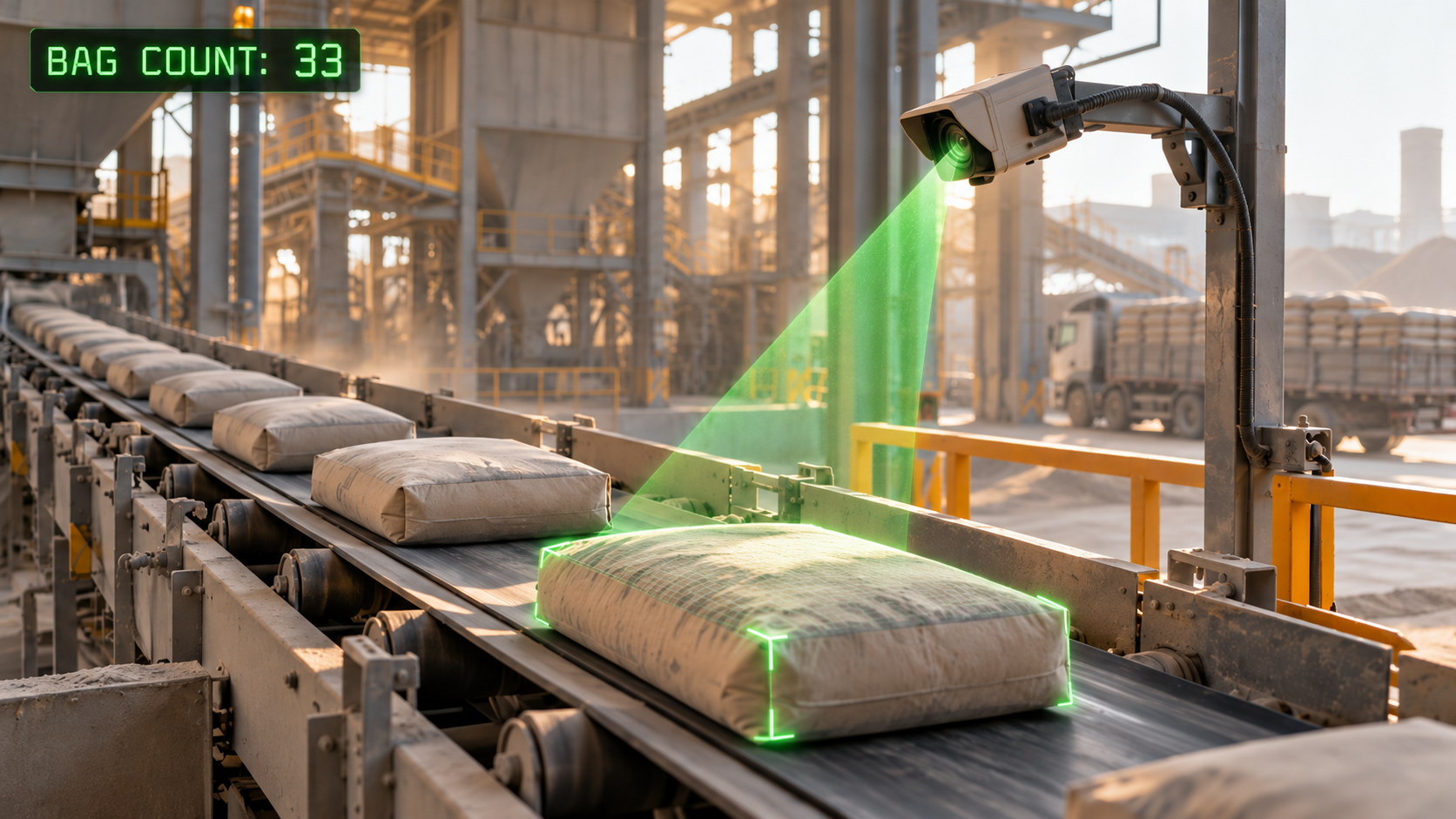
Helious Tech Solutions built AI Bag Counting as a module of Smart Store, its RFID-based warehouse management platform integrated with SAP and other ERPs. The design starting point is the dispute, not just the count: every number needs to be reconciled against weight and backed by a visual record.
Its key features:
- Real-time bag detection and counting. Computer vision counts bags on conveyors and at packer discharge, keeping pace with loading speed.
- Built for difficult conditions. Models trained on industrial footage handle touching or overlapping bags, torn bags, dust, backlight, and night-shift lighting, where beam sensors struggle.
- Trajectory-validated counting. A bag counts only when its tracked path meets a defined condition, preventing double counts from jitter and false counts from returned bags.
- Weight reconciliation. For truck dispatch, counts can be cross-checked against net weight from TAT Guard, Helious’s AI-unmanned weighbridge automation, so mismatches surface before the truck leaves the gate.
- Time-stamped visual evidence. An annotated image record for every consignment gives the plant proof when a dealer or transporter disputes a count.
- Live alerts with human confirmation. Alerts flag miscounts, discrepancies, or a blocked camera. When detection confidence is low, the system asks an operator to confirm rather than publish a doubtful number.
- Every loading point and bag type. It covers packer discharge, truck bays, and wagon loading, across PP woven, AD*STAR, kraft, and other cement bag formats.
- ERP integration on edge compute. Counts are tied to the vehicle and dispatch document and pushed to the ERP. On-premise processing means a network outage affects dashboards, not counting.
Because counts are tied to the dispatch document inside Smart Store, the count becomes part of the dispatch record, not a separate report. Rail-dispatching plants can pair it with Rake Guard.
Conclusion
An AI bag counting system is worth buying when bag disputes, short-supply claims, or manual tally errors are costing your plant real money. Its value is not just a more accurate number. It is a count that is tied to a vehicle, checked against weight, and backed by visual evidence.
Judge vendors on your own conveyor, during real shifts, with your bags. Ask what the system cannot see, how it behaves when the network or camera fails, and how counts reach your ERP. A system that passes those tests will hold up in front of a dealer and an auditor.