If the weighbridge is your cash register, a manual one is a till anyone can open. Here is what that costs, with every number either taken from a public source or derived from assumptions stated in full.
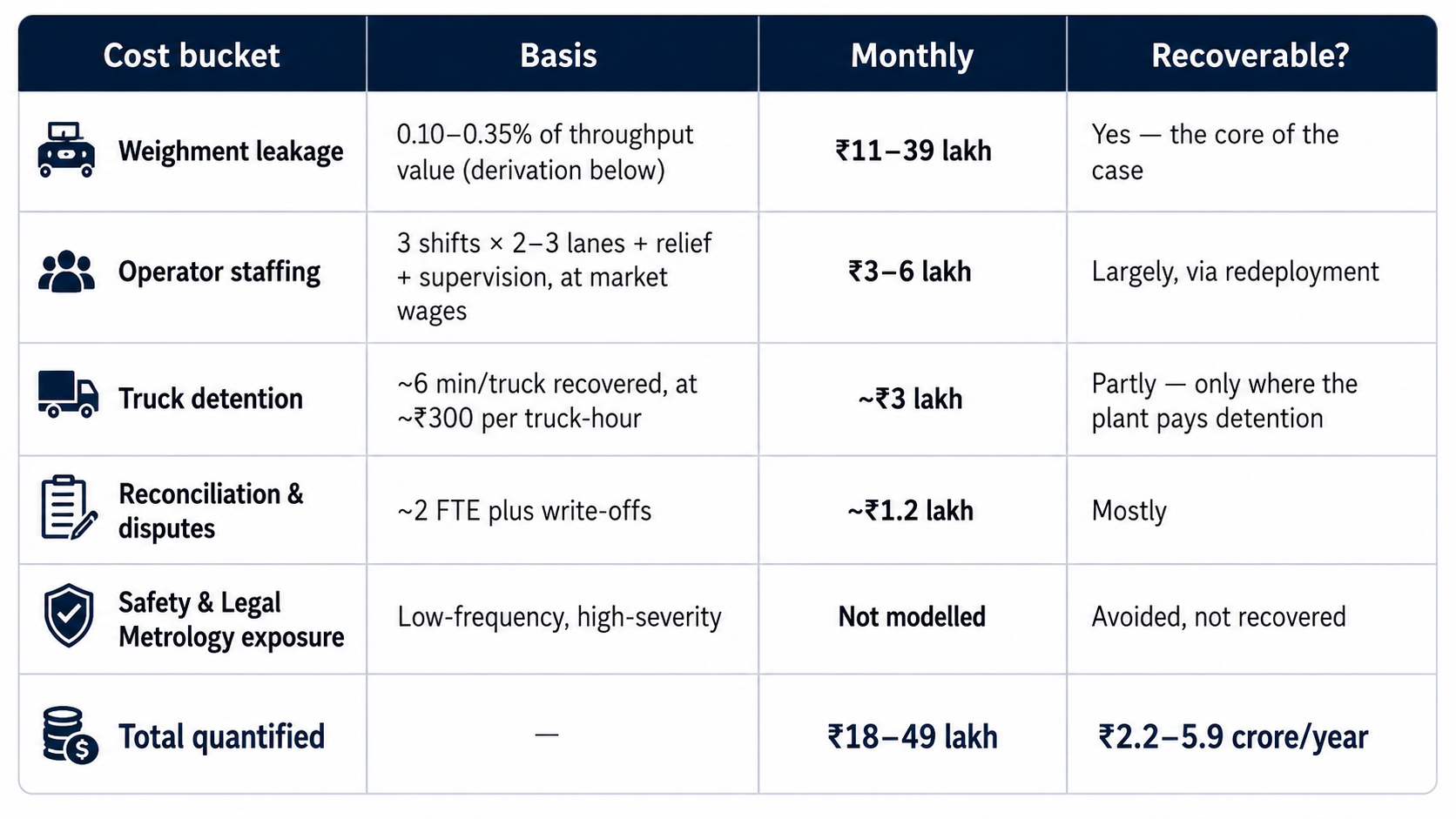
The Short Answer. For an Indian plant handling 300 truck movements a day, manual weighbridge operations cost roughly ₹18–49 lakh a month — ₹2.2 to ₹5.9 crore a year. That splits across weighment leakage (₹11–39 lakh), round-the-clock operator staffing (₹3–6 lakh), recoverable truck detention (~₹3 lakh), reconciliation and dispute labour (~₹1.2 lakh), and a lumpy tail of safety and Legal Metrology exposure that no monthly model captures well. None of it appears on a ledger line labelled “manual weighbridge.” That is precisely why it survives.
A Note on Method. Every figure in this model is one of two things: a number taken from a public source, statute, regulator norms, wage data, freight market rates, reported enforcement cases, or a derivation from assumptions stated openly enough that you can substitute your own. The sources are listed at the end. Nothing here asks to be taken on trust.
The Weighbridge is the Only Place Material Becomes Money
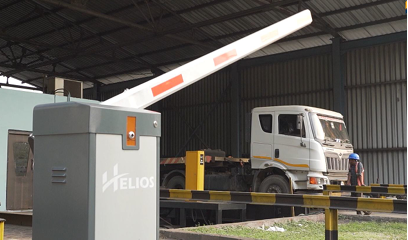
In most plants, the weighbridge is filed under hardware: a scale that produces a number. Operationally, it is something else entirely: the single point at which physical material is converted into a financial figure. Every gross, tare and net weight it records flows into billing, inventory valuation, GST documentation, statutory mining returns and month-end reconciliation. An error there does not stay there. It propagates through every downstream system, and it is discovered, if at all, weeks later by someone with no way to reconstruct what happened.
The structural weakness of the manual model is simple. The record shows what the system is told. An operator keys a value, a slip prints, the truck leaves. Nothing independently confirms that the vehicle on the platform is the vehicle on the paperwork, that no one is standing on the deck during the tare weighing, that the truck is fully positioned, or that the scale was at true zero before the load rolled on. Each gap is small. Annualised across a hundred thousand movements, they stop being small.
The Model, with the Assumptions Visible
Cost claims in this category are usually asserted rather than shown. Here is the arithmetic in full, so you can substitute your own numbers and disagree precisely.
The model plant: 300 truck movements a day, about 9,000 a month, over a hundred thousand a year at an average payload of 25 tonnes and a material value of ₹5,000 a tonne, representative of coal, ore, clinker and cement-grade flows. That is ₹112.5 crore of throughput crossing the deck every month, weighed on two to three lanes running 24×7. For finished steel at roughly ten times the per-tonne value, scale the leakage line accordingly; every other bucket stays put.
Cost 1: Weighment leakage — and why the “3–5%” figure is wrong
Start with the number you will see everywhere else, because it needs dealing with. A great deal of Indian weighbridge software marketing asserts that manual weighing causes 3–5% material loss. Trace it, and there is no study underneath it; it is vendor copy, repeated between vendors until it acquired the texture of a statistic.
It fails two tests. The first is arithmetic: three per cent of ₹112.5 crore of monthly throughput is ₹3.4 crore a month, and no operator on earth is losing that at the weighbridge without noticing. The second is regulatory: the Central Electricity Regulatory Commission’s tariff norms allow coal-fired stations transit and handling losses of just 0.20% for pithead plants and 0.80% for non-pithead plants, and that norm covers the entire journey from mine to bunker, rail haulage and multiple handlings included. If India’s power regulator prices the whole logistics chain at under one per cent, a claim that a single weighbridge loses 3–5% is not aggressive marketing; it is incompatible with how the country’s own regulator accounts for material.
What the 3–5% band actually describes, when it describes anything, is end-to-end supply chain shrinkage: moisture variance, handling and spillage, stockyard loss, transit pilferage, sampling and assay differences. The weighbridge is one node in that chain and is responsible for a small share of it.
The weighbridge-attributable figure can be bracketed from public documents. The floor comes from the instrument itself: under the Legal Metrology (General) Rules, 2011, which track the international OIML R 76 standard, even a freshly stamped, fully compliant weighbridge is permitted in-service errors of the order of a scale division per weighment — ±20 kg and upward on a typical 60-tonne bridge with 20 kg divisions. Tolerance of that kind is random and largely cancels across nine thousand monthly movements; what survives aggregation is directional bias, and directional bias at a manual bridge has a name.
The ceiling comes from the regulator’s sub-1% norm for the entire chain, above. Between those bounds, the portion an automation layer can actually see, block and recover sits at 0.10–0.35% of throughput value — ₹11–39 lakh a month on the model plant. It is an order of magnitude smaller than the number in circulation, and unlike that number it survives a CFO asking where it came from.
It is also more than enough, and it is not hypothetical. Three enforcement cases from 2026 alone show the mechanisms operating at industrial scale:
– Ahmedabad, April 2026. The city’s Crime Branch arrested seven men running an inter-state racket that installed chips and remote-control devices in electronic weighbridges to under-record scrap purchases; investigators pegged the fraud at ₹50–100 crore, with some of India’s largest industrial groups among the affected sellers.
– Nagpur, April 2026. Police unravelled a steel-diversion operation on consignments dispatched from a public-sector steel plant, in which weighbridge software was tampered with mid-weighment so that records showed the original weight even after tonnes of steel had been offloaded en route.
– Thane, June 2026. Police booked a scrap contractor whose vehicle carried a concealed sand compartment ballast weighed in at gross, discharged at an unknown point, moving 21 tonnes of aluminium scrap worth about ₹46 lakh out of construction sites behind clean-looking slips.
Note what the three share: in every case the scale hardware weighed correctly. The record layer was the target. Four mechanisms produce almost all weighbridge-attributable leakage:
– Tare-weight manipulation. A helper stands on the deck during the empty weighing, or the vehicle carries concealed ballast. The billed net rises without a gram of extra material moving.
– Ghost trips. One genuine movement, billed twice, the easiest fraud to run and the hardest to spot in a paper register.
– Tag swapping. Where basic RFID is deployed, the tag is the identity. Move the tag, move the identity.
– Partial weighing. The truck stops short so an axle group sits off the platform, on whichever weighment pass favours the fraud. On outbound dispatch that understates what leaves; on inbound receipt, a short tare overstates what arrived.
All four share one property: they are invisible to a system whose only witness is a person or a tamperable record, and they are trivially detectable to a system that photographs, positions and verifies every transaction independently.
Cost 2: Staffing that Scales with Lanes, not with Software
A manual weighbridge needs an operator. Weigh around the clock, and it needs three shifts of them, plus weekly-off relief, plus supervision, and that roster repeats for every lane and every site you add. At market rates, the roster is knowable: job-posting and salary-aggregator data across Indian industrial belts place weighbridge operators at roughly ₹14,000–24,000 a month, with shift supervisors above that band. For the model plant’s two to three lanes running 24×7 — nine to thirteen operators, three to four supervisors, a slip clerk or two, the loaded monthly bill lands between ₹3 and ₹6 lakh. It also buys you the human layer that every one of the four fraud mechanisms above depends on.
The structural point is more important than the salary line. In a manual model, throughput and headcount are chained together: to weigh more trucks you hire more people, and each additional person adds variance and exposure. Automation breaks the chain. Capacity scales with software; exception handling and supervision do not scale with lane count.
The effect compounds on multi-site estates: one automation layer amortises across every bridge, so the headcount-per-bridge ratio falls as the estate grows. A single-bridge site should not expect the same ratio; its saving is the shift roster itself, not the ratio.
Cost 3: Cycle Time, Detention, and the Throughput you Never Capture

Be careful with the numbers here, because this is where vendor claims usually break. A manual weighment at the deck, approach, stop, operator entry, capture, print, verify, barrier, typically runs 4 to 8 minutes. Measured gate-to-gate, including queue, the same movement commonly takes 12 to 20 minutes at peak dispatch. Anyone quoting you 15 minutes for a deck cycle is inflating, and any plant head with a stopwatch will catch it.
An automated camera-native cycle, weight capture, driver verification, load imaging, digital slip, ERP sync, completes in under a minute and runs continuously through shift changes, night hours, and breaks.
Two caveats worth stating plainly, because they change the ROI:
Detention savings accrue to the transporter unless your contracts make you pay for it. Where you do pay, the market gives you the rate: transporter detention and halting charges in India run ₹1,000–3,000 a day, and fixed-cost analyses of heavy-truck economics — EMI plus driver — put a large vehicle’s standing cost near ₹3,000 a day, about ₹300 per productive hour. Six recovered minutes per truck across 300 movements is about 30 truck-hours a day; at ₹300 an hour, roughly ₹3 lakh a month.
The larger prize is usually not the detention line at all; it is dispatch capacity recovered on infrastructure you have already built. For a plant missing rake or shipment windows, that is worth more than the labour saving and the detention saving combined.
Cost 4: Disputes, and the Evidence Problem Underneath them
Not every loss is fraud. A mistyped vehicle number, a transposed digit, a wrong material code- each creates a discrepancy someone downstream must chase, and each consumes finance and logistics hours that never get costed back to the weighbridge. On the model plant, two full-time equivalents in finance and logistics chasing weighment discrepancies, plus the write-offs conceded rather than argued, is around ₹1.2 lakh a month.
The deeper issue is evidentiary. When a manual slip is challenged, what exists to settle it? A paper record and a recollection. There is no time-stamped image of the vehicle, no verified driver identity, no independent zero-check, no tamper-evident log. You cannot prove you were right, so commercially you concede, and the cost of manual weighing turns out to include not just the wrong number, but the goodwill and the labour burned failing to establish the right one.
Cost 5: Legal Metrology Exposure, the bucket Nobody Prices
This is the one that never appears in a vendor cost model, and it is the one a board should care about most.
Under Section 24 of the Legal Metrology Act, 2009, weighing instruments used in trade must be verified and stamped by a Legal Metrology officer. Section 25 penalises use of a non-standard weight or measure. Section 26 penalises alteration of one. Section 44 covers counterfeiting or tampering with a verification seal or stamp, and carries imprisonment of not less than six months.
Be honest about magnitude: first-offence fines are modest, up to ₹25,000 under Section 25, with imprisonment on the table for repeat offences. That is not the exposure. The exposure is threefold. These are criminal provisions, not civil ones. Section 49 permits a court to order publication of the name and place of business of a convicted company. And in regulated extraction, a weighbridge record that cannot withstand audit undermines every statutory return built on top of it — state mining e-transit regimes such as i3MS in Odisha, eMM-11 in Uttar Pradesh and eRawanna in Rajasthan all reconcile against weighment data, and manual overrides and gaps are exactly what auditors pull on.
Add to that the physical dimension: manual operation puts people on and around a live deck, which is the same behaviour that enables tare fraud. One incident can cost more than a year of the daily leaks. Prudent operators price it in even though it will not appear on any month’s P&L.
What an Automation Layer has to do to Actually Close these Gaps

Not every system marketed as weighbridge automation addresses the cost buckets above. Independent of vendor, these are the capabilities that map to the leaks — use it as an evaluation checklist:
– Vehicle identity that survives tag swapping. A tag reader identifies a tag. You need at least two independent identity signals cross-checked against each other.
– Human-presence detection on the deck. Without it, tare manipulation is undetectable regardless of how good the identification is.
– Independent zero verification before every transaction. Not a periodic calibration check — every transaction.
– Positioning confirmation. Proof the whole vehicle is on the platform, not merely that something is.
– Material verification. Load imaging so what is billed matches what is in the bed.
– Driver identity binding. The person on the slip and the person on the deck must be the same person.
– A tamper-evident, exportable evidence record. If a transaction cannot be reconstructed in an audit two years later, it did not solve the dispute problem — and after 2026’s software-tampering cases, “the system said so” is no longer evidence.
– Native ERP write-back. A system that produces a report someone re-keys into SAP has replaced one manual step with another.
How Helious Closes it: TAT Guard
Seeing the cost is the easy half. Closing it on every truck, on every shift, without adding a new manual layer, is the hard half, and it is what TAT Guard, the AI unmanned weighbridge module of the Helious platform, was built to do.
The architectural difference is that TAT Guard is camera-native. The automation and verification layer runs on computer vision, no beam cutters, no loop detectors, no embedded position sensors. Load cells still perform the physical weighing, as they do on any weighbridge of any architecture; everything above that layer is vision. Three consequences follow, and they are the reason the architecture matters commercially rather than just technically:
– It retrofits. No trenching, no civil work, no deck reconstruction; the existing bridge and its Legal Metrology verification stay as they are.
– It works on third-party fleets. Nothing has to be tagged in advance, so it functions on open and commercial bridges with unknown vehicles, not only captive fleets.
– It improves through software. New material types and vehicle classes arrive as model updates, not hardware replacement, and there are far fewer physical failure points in the field.
The 2026 tampering cases above are the argument for this architecture in miniature: when the record layer is the target, the defence has to be an independent witness to the physical event, not a better password on the same terminal. Mapped to the five cost buckets, that means:
– Multi-signal vehicle identity — ANPR number-plate recognition, AI vehicle profiling and Vahan/Sarathi government verification cross-checked together, so a swapped tag or a ghost trip fails the cross-check.
– Biometric driver verification, binding the person on the deck to the person on the slip.
– AI human-presence detection on the platform, blocking the tare manipulation vector at source.
– Automatic zero verification and camera-based tyre tracking before every transaction, ending partial-weighing and stale-reading fraud.
– Top-view load imaging for material verification against the consignment record.
– A ~45-second unmanned cycle with AI weight-stability validation and native write-back into SAP, Oracle or your stack, tamper-evident, VAPT-tested, and reconstructable transaction by transaction.
What To Do First
Do not start with a vendor; start with a baseline. It is the exercise worth running before taking any sales call, including ours, because the number will make the decision for you and you will need it to hold anyone accountable afterwards:
1. Measure your actual variance. Reconcile weighbridge net against stockyard or production consumption for one full month, material by material. Do not accept an annual average — the monthly figure is where the pattern shows.
2. Time your cycle honestly. Separate deck time from gate-to-gate time. Both matter; conflating them will mislead your own business case.
3. Count the dispute hours. Ask finance how many person-hours went into weighment disputes last quarter, and how much was written off rather than argued.
4. Check your stamping and audit position. When was each bridge last verified, and could you reconstruct any single transaction from six months ago on demand?
Four numbers, one month of effort, and you will know whether this is a ₹30 lakh problem or a ₹3 lakh one at your site before anyone sells you anything.
If you would rather see an indicative figure first, the ROI calculator turns your truck volume, tonnage value, and current cycle time into a monthly estimate without a call. If you are further along and comparing architectures, the weighbridge automation buyer’s guide covers evaluation criteria and commercial models, and camera-only versus sensor-based weighbridge automation goes deeper on the technical trade-off.
Manual weighbridge operations are not a saving. They are a cost you have stopped noticing and one of the few on a plant that pays back in hard cash when you fix it.
Sources and Method
– Legal Metrology Act, 2009: Sections 24 (verification and stamping), 25 (use of non-standard weights and measures; first-offence fines up to ₹25,000), 26 (alteration), 44 (counterfeiting and tampering with verification seals; minimum six months’ imprisonment), 49 (offences by companies, including court-ordered publication of the convicted company’s name and place of business).
– Legal Metrology (General) Rules, 2011, read with OIML R 76: maximum permissible errors for non-automatic weighing instruments; in-service tolerances of the order of one scale division at capacity.
– CERC (Terms and Conditions of Tariff) Regulations: normative coal transit and handling losses of 0.20% (pithead) and 0.80% (non-pithead), retained unchanged into the 2024–29 control period.
– Reported enforcement cases, 2026: Ahmedabad Crime Branch weighbridge-tampering arrests, fraud estimated at ₹50–100 crore (April 2026, reported via IANS); Nagpur steel-diversion investigation involving weighbridge software tampering (April 2026); Thane concealed-ballast scrap diversion case, 21 tonnes / ~₹46 lakh (June 2026).
– Wage data: Indeed and Glassdoor salary listings and live job postings for weighbridge operators in India, 2025–26 (approximately ₹14,000–24,000 per month).
– Freight economics: published Indian transporter detention and halting norms (₹1,000–3,000 per day) and fixed-cost analyses of heavy-truck daily economics (~₹3,000 per day in EMI and driver cost).
– Helious operating estimates: the recoverable leakage band (0.10–0.35% of throughput value) and the cycle times (4–8 minutes at deck; 12–20 minutes gate-to-gate at peak) are drawn from deployed-site experience, bracketed by the instrument-tolerance floor and the regulatory transit-loss ceiling above. These are the two figures in this model you should replace with your own measured numbers — the four-step baseline exists for exactly that purpose.
Conclusion
Manual weighing is rarely a decision. It is an inheritance, and it quietly bills you every shift, in tare fraud you cannot see, and dispute hours nobody costs back to the deck. So do not start with a vendor. Run the four-step baseline: one month of variance, honest cycle times, dispute hours, stamping position. The number will decide for you, and you will need it to hold anyone accountable afterwards, including us. When you are ready to compare architectures, the question that matters in weighbridge automation India is whether the system independently witnesses the physical event or merely records what it is told. Any unmanned weighbridge system worth its price answers that. Contact us when you have your number.