Quick Summary
A Wagon Tippler Automation Retrofit upgrades an existing tippler's controls, sensors and software without replacing its mechanical structure. This guide explains how to assess your tippler, where PLC automation ends and AI vision begins, the retrofit sequence, what drives Wagon Tippler Retrofit Cost, and the limitations plants should plan for before committing budget in 2027.
Introduction
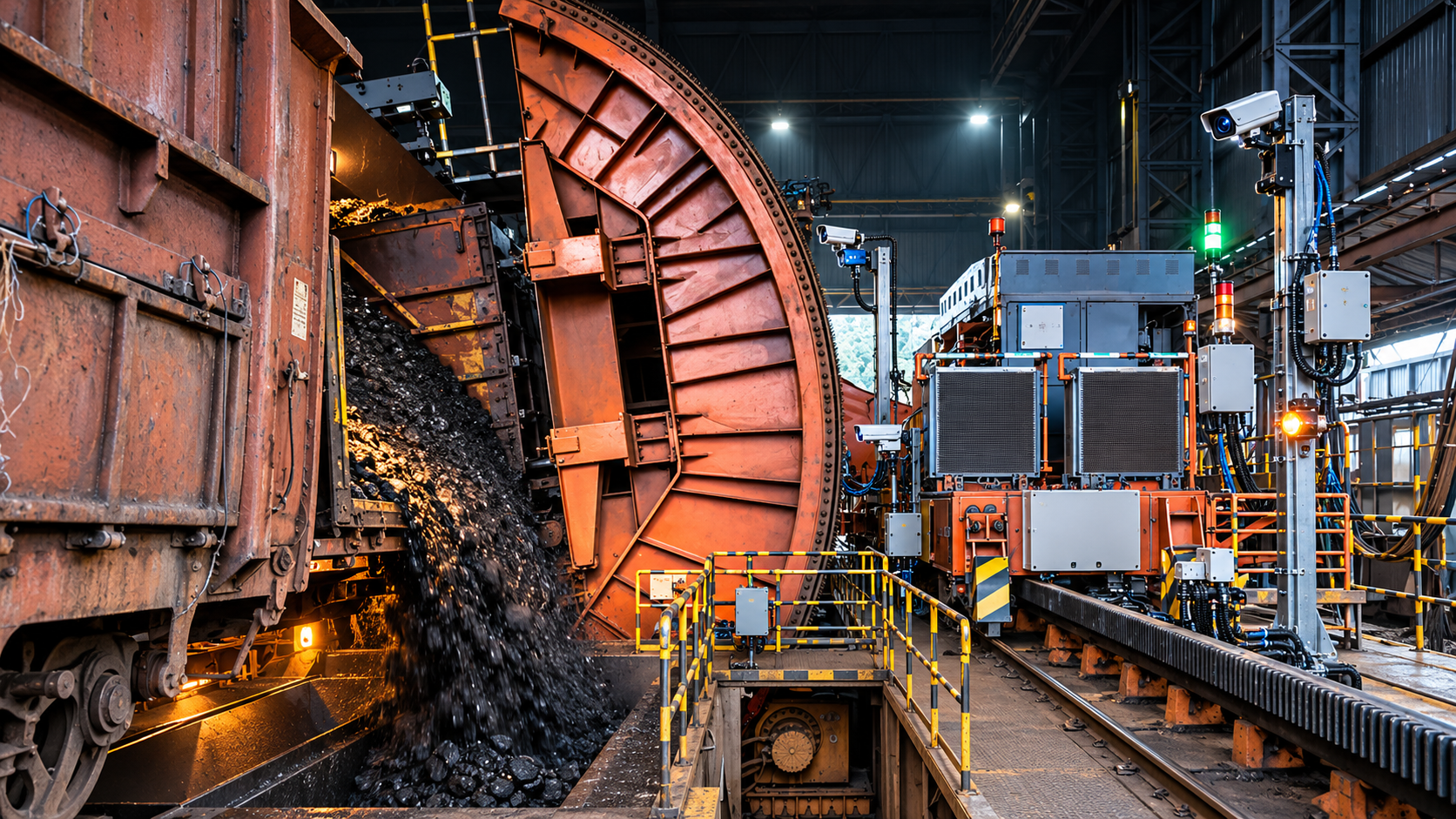
Most wagon tipplers in Indian steel, power and cement plants were not built badly. They were built for a different era of control. The cradle, clamps and drive often remain serviceable after decades of work. What ages out is everything around them: relay panels nobody fully understands any more, an operator judging a rake through a dusty cabin window, and wagon numbers written in a register before someone types them into the ERP at shift end.
Anyone who has worked a rake siding knows the result. A clamp limit switch fails and the tippler waits for an electrician. A wagon gets tipped twice because nobody was sure it was empty. Someone is near the cradle when they should not be. Meanwhile, demurrage keeps running.
Replacing the entire tippler is hard to justify when the structure is sound. That is why a Wagon Tippler Automation Retrofit has become the practical route: keep the mechanical asset, and rebuild the control and intelligence layers around it. This guide covers how to do that properly, which tasks belong to PLC logic and which to AI, and what to check before money is spent.
The Three Layers of a Wagon Tippler Retrofit
A retrofit works across three distinct layers. Treating them as one "automation package" is the most common reason projects underdeliver, because each layer solves a different kind of problem.
Layer 1: Wagon Tippler PLC Automation
Wagon Tippler PLC Automation handles deterministic sequence control. That means indexing the wagon into the cradle with the side arm charger or beetle, confirming position, clamping, rotating to the tipping angle, holding for discharge, returning, unclamping and releasing. It also enforces interlocks, such as no rotation until clamp pressure is confirmed and no indexing unless the cradle is at its home position.
In a retrofit, this layer usually involves replacing relay logic or an obsolete PLC, adding absolute encoders for cradle angle, fitting variable frequency drives where older starters are still in use, and installing hydraulic pressure transmitters and a modern HMI or SCADA screen.
A PLC excels at "if this signal, then that action." It cannot tell whether a wagon is empty, whether a person is standing in the zone, or which wagon number it is handling.
Layer 2: AI Wagon Tippler Automation
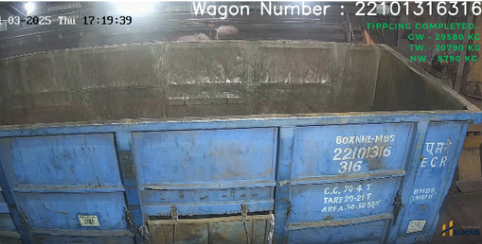
AI Wagon Tippler Automation adds camera-based perception for exactly those questions. Typical capabilities include wagon number recognition, alignment checks before clamping, human presence detection around the cradle, residual material detection after tipping, and wagon body inspection for bulged sides or damage. The AI output should feed the PLC as a permissive or an alert, not drive motors directly.
Layer 3: Wagon Tippler Automation Software
The wagon tippler automation software ties events together into wagon-wise records: cycle times, stoppages, re-tips, alarms and operator actions. It is also where integration happens with in-motion weighing, FOIS rake data and the plant ERP. Without this layer, a modernised tippler still produces data that nobody can use.
Assess the Tippler Before You Automate It
Automation does not fix worn machinery. If maintenance on the tippler is already behind, a faster, tighter control system will expose mechanical faults sooner rather than hide them. A proper assessment should cover:
- Mechanical condition: cradle structure, trunnion bearings, girth gear and pinion wear, clamp cylinders and hydraulic power pack.
- Existing controls: relay logic or PLC, availability of drawings, and whether spares for the current PLC are still obtainable.
- Drives: motor type and starting method, and whether VFDs are feasible within the panel room.
- Wagon mix: the wagon types handled and the condition of painted wagon numbers, which directly affects recognition accuracy.
- Environment: dust load, vibration, night operations, lighting and power quality at camera locations.
- Data destinations: ERP, weighbridge, FOIS and any existing rake management system.
- Shutdown windows: how many hours of downtime operations can realistically give the project.
This assessment decides the scope, and the scope decides almost everything about cost and timeline.
Step-by-Step Wagon Tippler Automation Retrofit Process
- Baseline the current operation. Time each stage of the cycle across several rakes: positioning, clamping, tipping, return and waiting. Without a baseline, nobody can prove the retrofit improved anything.
- Write the functional specification. Prepare the I/O list, sequence description and a cause-and-effect matrix for every interlock. This document prevents most commissioning disputes.
- Upgrade field instrumentation. Replace unreliable limit switches with proximity sensors, add cradle angle encoders and pressure transmitters, and correct cabling faults found during the survey.
- Build and test the new control panel offline. Run a factory acceptance test with simulated I/O, then cut over during a planned shutdown. Keep the old panel available for rollback where space allows.
- Install cameras and tune the AI models. Use industrial enclosures with air purging, fix lighting for night shifts, and validate models on your own wagons. Run AI in advisory mode first, logging its decisions without letting it act.
- Integrate the software. Connect wagon-wise records to the in-motion weighbridge, FOIS data and ERP, and agree on data ownership early.
- Commission in stages. Move from supervised operation to automatic cycles only after the site acceptance test and a sustained period of stable running.
- Train and hand over. Operators, electricians and IT staff each need different training. Leave behind updated drawings and a spares list.
What Drives Wagon Tippler Retrofit Cost
There is no honest single figure for Wagon Tippler Retrofit Cost. Two plants with identical tipplers can receive very different quotes because their starting points differ. The main cost drivers are:
- Scope: a controls-only upgrade costs far less than full Wagon Tippler Modernization that includes drives, hydraulics and vision.
- Mechanical rectification discovered during the assessment.
- Drive replacement, especially when moving from older starters to VFDs.
- Camera count, enclosures, lighting and the network backbone needed to carry video.
- Software and integrations, since each ERP, weighbridge or FOIS link adds engineering effort.
- Shutdown time, which carries its own production cost.
- Annual maintenance for cameras, models and software.
The better comparison is not retrofit versus nothing. It is retrofit cost against what the current operation already loses through demurrage, re-tipping, breakdown hours and manual reconciliation. Calculate those using your own plant data before evaluating any quote.
Limitations and Implementation Realities
Vision systems at a tippler work in some of the harshest conditions in a plant. Coal and ore dust settle on lenses, vibration loosens mounts, and lighting changes sharply between day and night. Cameras need a cleaning schedule, just as conveyor scrapers do.
Wagon number recognition depends on the paint on the wagon. Faded, overpainted or damaged numbers will lower read rates, so the system needs a defined manual fallback rather than a silent failure.
AI-based human detection adds a strong safety layer, but it should work alongside hardwired emergency stops and guard interlocks, not replace them. Safety reviews should treat vision as an additional protection layer.
Finally, operator trust takes time. Teams that have run a tippler by eye for years will override automation they do not understand. Advisory-mode operation and clear alarm screens help build that confidence.
How Helious Rake Guard Approaches Wagon Tippler Modernization
Helious Tech Solutions treats the tippler as one stage in the rake lifecycle rather than an isolated machine. Its AI-driven rake management system, Rake Guard connects tippler automation with what happens before and after unloading. The modules relevant to a retrofit are:
- Wagon Tippler Automation System: Position, tip and reset are governed by AI logic. After each tip, cameras inspect the wagon bed and trigger a re-tipple automatically if material remains, which addresses the uncertainty behind unnecessary double tipping.
- Zero-Human-Presence Verification: Vision checks for people in the tippler zone before every cycle, adding a safety permissive that does not depend on a key switch.
- Wagon Health and Bulged Wagon Detection: Deformed wagons are flagged on approach and diverted before they can jam inside the cradle and stop the line.
- Tippler and Hopper Allocation: The system reads rake composition, tippler availability, material type and hopper status, with camera-based alignment checks, blockage detection and rerouting during downtime.
- Wagon-Wise In-Motion Weighing and Reconciliation: Gross weight is captured per wagon, tare applied, and net validated against FOIS with digital slips and mismatch alerts.
- Live Rake Tracking and FNR Verification: Rake position comes from FOIS, so the tippler team can prepare before the rake reaches the siding.
Together, these modules work as the wagon tippler automation software layer described earlier, linking cycle events to rake and weighment records.
Conclusion
An existing wagon tippler with a sound structure rarely needs replacement. It needs reliable sequence control, the ability to see what operators currently guess at, and software that turns every cycle into a usable record. A well-planned Wagon Tippler Automation Retrofit delivers all three, provided the mechanical condition is checked first and AI is treated as a layer on top of PLC logic and hardwired safety rather than a substitute for them.
Start with a baseline and an honest assessment. Those two steps will tell you the right scope, the realistic cost and whether 2027 is the year to do it.