Quick Summary
Railway demurrage charges in India are levied per wagon per hour once free time expires, on a graded scale that escalates the longer a rake sits. Wharfage is a separate charge for goods not cleared from railway premises. This article breaks down the exact calculation logic behind both, free time rules, rate slabs, and worked wagon-hour examples, so plant and logistics teams running rail rake demurrage reduction efforts can predict and audit their bills.
Introduction
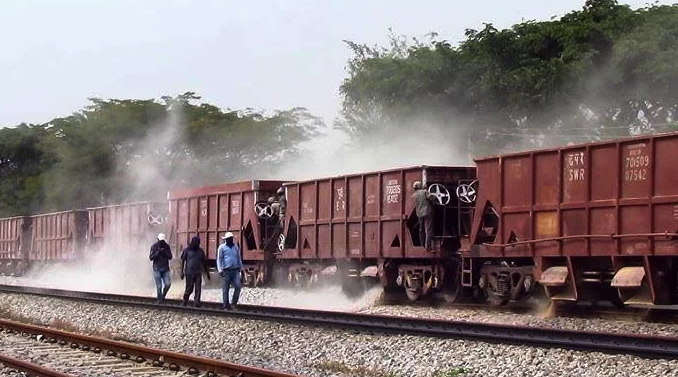
A rake sits on a siding two hours longer than planned because the unloading crew is short-staffed that shift. Nobody at the plant treats this as a billing event — it feels like an internal scheduling problem. Then the goods bill arrives with a demurrage line the commercial team wasn't expecting, calculated on a formula most operations staff have never actually seen written out.
This happens constantly across Indian Railways' freight network, from steel plant sidings to cement dispatch yards to coal loading points. Demurrage and wharfage aren't penalties applied at the Railway's discretion — they're computed off rules in the Railway Board's compendium on the subject, with defined free-time windows, graded rate slabs, and terminal-specific variations.
Most confusion around railway demurrage charges in India comes not from the charges being arbitrary, but from teams not knowing which free-time rule applies to their wagon type and terminal, and not tracking the clock the same way FOIS does. This is also where a rake management system in India earns its keep, not by changing the tariff, but by tracking the same clock Railways uses.
This article works through the actual calculation — what starts the clock, what free time applies, how the graded rate escalates, and how wharfage differs from demurrage — with wagon-hour worked examples you can apply to your own dispatch data.
What Demurrage Charge Actually Is
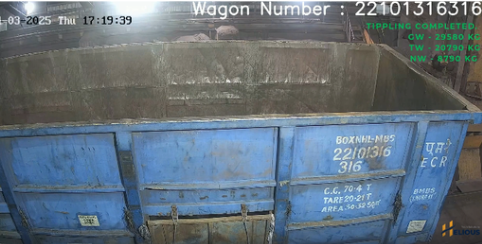
Demurrage is levied for detention of Indian Railways' rolling stock — wagons — beyond the free time allowed for loading or unloading. It's a charge on the wagon, not the goods. The moment a rake is placed, a clock starts; if wagons are released before free time expires, no demurrage applies, and if they aren't, it accrues per wagon per hour beyond that threshold.
This is distinct from wharfage, charged when goods sit on railway premises — a shed, platform, or wharf — after free time for removal has expired. A rake can clear demurrage while unloaded cargo still triggers wharfage because nobody moved it off the shed floor. If loading/unloading itself overruns, both charges can apply concurrently, since they track two different clocks: wagon detention and cargo dwell time.
Both exist for the same reason: wagons and goods sheds are shared network assets. A rake stuck on a siding for eighteen hours because a plant's material-handling can't keep pace isn't just that plant's problem — it's a wagon Railways can't circulate to the next customer.
How Free Time Is Determined
Free time isn't a single number. It varies by wagon type, whether loading/unloading is mechanized or manual, the terminal type, and in several cases the number of wagons in the rake. Indian Railways' compendium lays out separate tables for standard goods sheds not on an Engine-on-Load (EOL) basis, each of the seven old steel plants individually (Bhilai, Bokaro, Durgapur, IISCO, Rourkela, TISCO, Vizag), other steel plants, and EOL terminals, where free time runs tighter since the locomotive stays coupled.
Open wagons (BOXN, BOXNHA and similar) at a standard non-EOL goods shed get 5 hours mechanized loading, 7 hours mechanized unloading, and 9 hours for either operation done manually. Covered wagons and BCNHL stock follow a stepped scale — free time increases with rake size, from 5 hours for 1–20 wagons up to 11 hours for 46 wagons and above.
This matters directly for bulk commodity movement: zonal railways can compress free time for coal and/or iron-ore rakes at high-throughput sidings — down to 3 hours for mechanized loading and 5 hours for mechanized unloading, at terminals notified for this reduced window. That's tighter than the standard 5–7 hour allowance, and it targets sidings where multiple rakes load from a single line — exactly the congestion pattern behind demurrage exposure at coal yards and high-volume cement sidings.
One detail that regularly surprises plants: if a rake is placed in multiple parts — say, across two spurs because the siding can't take the full rake at once — free time starts from the first placement, and the "dies non" (non-counted) gap between completing one part and placing the next is excluded from the detention clock. Splitting a rake across spurs doesn't buy extra time beyond the genuine placement gaps.
The Rate Structure: How Demurrage Actually Escalates
This is the part most plant teams get wrong. Demurrage is not a flat per-hour rate — it's graded, and it gets progressively more expensive the longer detention runs.
The current base rate is ₹150 per 8-wheeled wagon per hour, or part of an hour, for detention within the first 6 hours beyond free time. Past that point, the rate escalates:
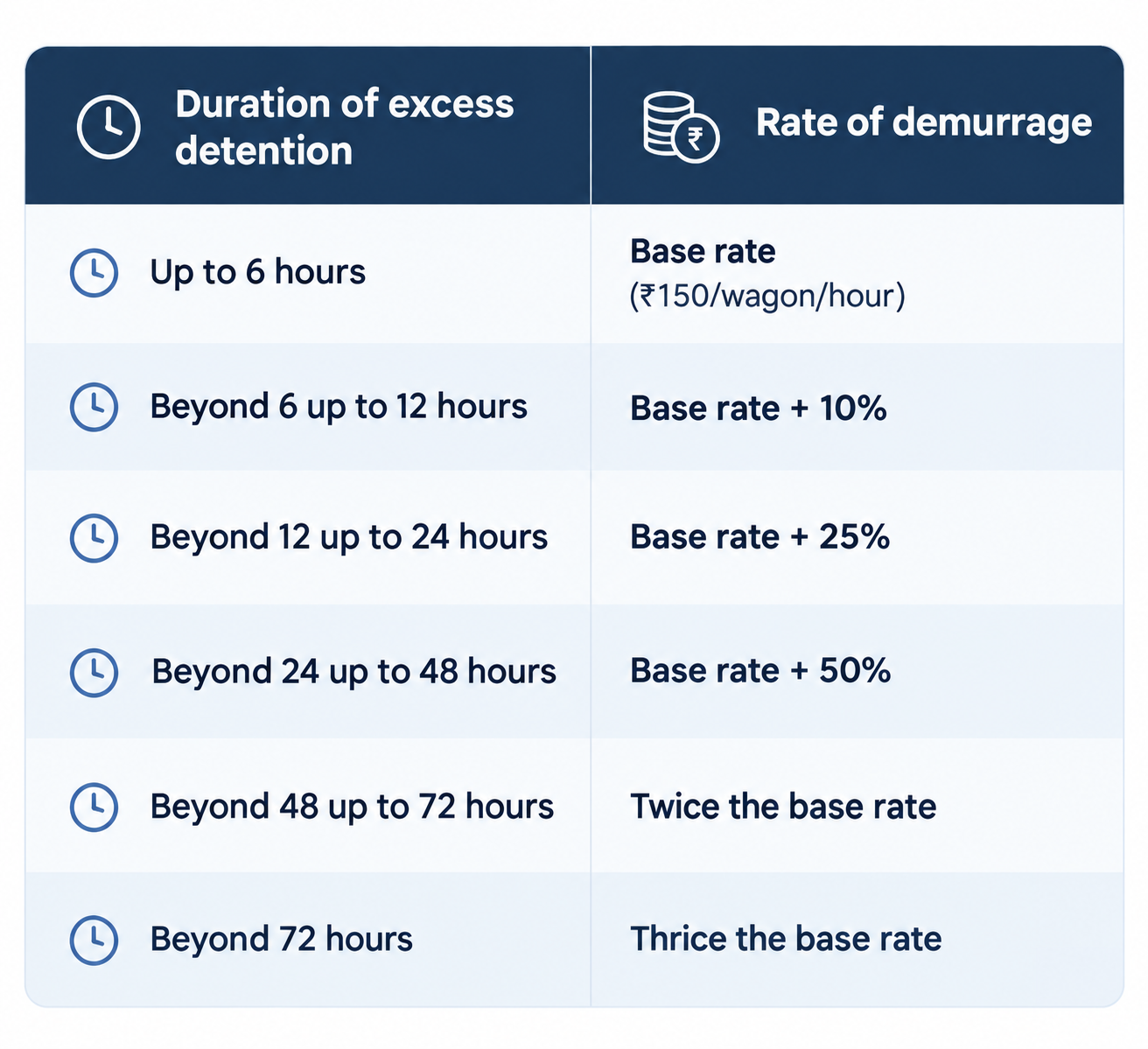
Four-wheeled wagons are charged at half the 8-wheeled rate. On top of this graded structure, divisional officers can impose penal demurrage at up to six times the base rate during periods of excessive congestion at a terminal, provided 24 hours' notice is given.
Worked Example: 42-Wagon Rake, 18 Hours Excess Detention
Take a rake of 42 open (BOXN) wagons at a non-EOL goods shed, mechanized unloading, free time 7 hours. The rake is released 25 hours after placement — 18 hours beyond free time. That splits across the graded bands:
- First 6 hours at base rate: 6 × ₹150 = ₹900/wagon
- Next 6 hours at base + 10% (₹165): 6 × ₹165 = ₹990/wagon
- Remaining 6 hours at base + 25% (₹187.50): 6 × ₹187.50 = ₹1,125/wagon
Total per wagon: ₹3,015. Total for the rake: ₹3,015 × 42 = ₹1,26,630 — for one detention event on one rake. Run that pattern across several rakes a week, and it compounds into a cost line rarely traced back to the specific bottleneck that caused it.
Source: Rates Master Circular on Demurrage, Stabling, Wharfage, Stacking, Waiver and Write-off
The same math explains why the coal carve-out matters operationally: a 9-hour loading duration that produces 2 excess hours at a standard 7-hour siding produces 6 excess hours at a siding notified for the reduced 3-hour window — three times the billable exposure, purely because of where the rake is loaded.
Wharfage: A Separate Charge, A Separate Clock
Wharfage rates depend on how a goods shed or station is classified, based on average monthly rake volume:
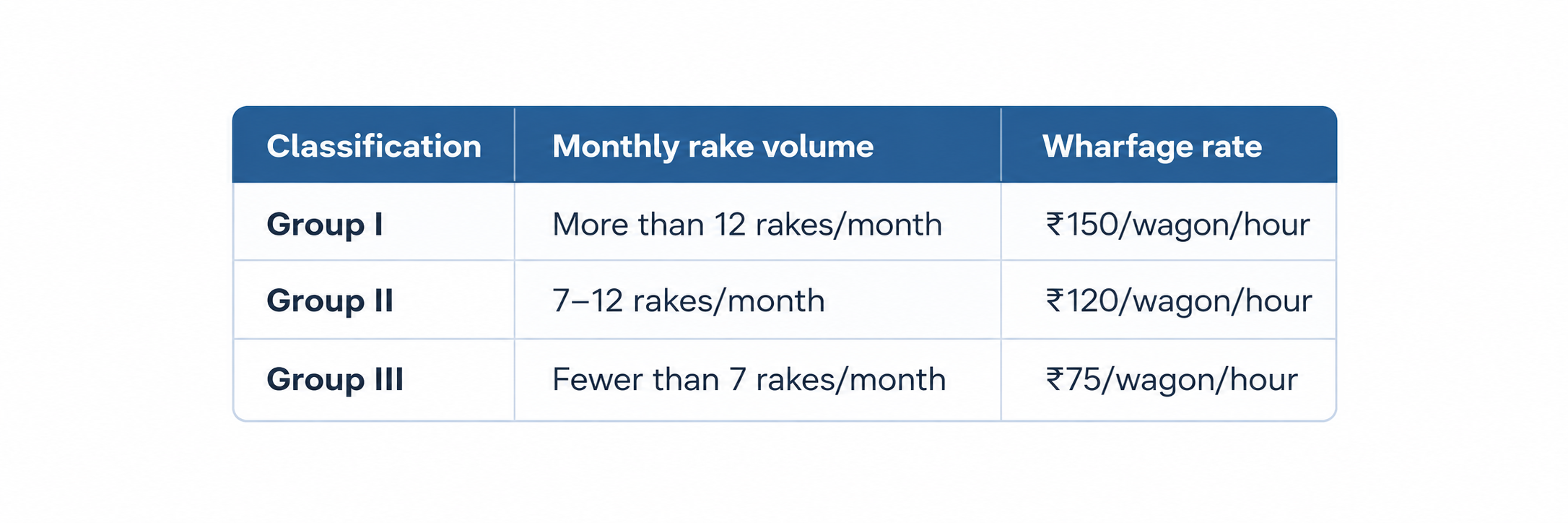
Free time for removal also varies by group — 12 working hours for Group I, 15 for Group II, and a notably longer 72 hours for Group III, reflecting lower traffic pressure at smaller sheds. Wharfage isn't levied on goods still inside a wagon or at a private siding — it applies to cargo on railway premises after unloading, or stacked waiting to load, once removal free time has lapsed.
Where this trips plants up: if a rake overruns its unloading free time and the unloaded cargo isn't cleared within its own removal free time, both charges apply concurrently on the same consignment — one for the wagon, one for the goods.
What the Charge Math Doesn't Capture
The compendium's rules are precise, but they don't account for why detention happens. A rake held up by a strike, bandh, heavy rains, or another circumstance genuinely beyond the consignor's or consignee's control can be considered for waiver — but only on formal application within a fixed window (typically 10 days), with documentary evidence, and only after the charge has already been paid in full. Waiver is discretionary and not meant to be granted routinely for detentions within the customer's control.
In practice, the calculation is deterministic and auditable, but the dispute process is administratively heavy and slow. The stronger lever for most plants isn't chasing waivers after the fact — it's having an accurate, timestamped record of when a rake was placed, when loading/unloading finished, and when it was released, so billed demurrage can be checked against what actually happened at the siding. This is precisely the gap that rake unloading automation and live FOIS tracking integration are built to close.
How Helious Rake Guard Addresses This

Demurrage and wharfage disputes are usually won or lost on timestamp accuracy, not on the underlying tariff rules. Most plants running rail logistics on phone calls and manual FNR checks have no independent way to verify a bill against what actually happened at the siding. Rake Guard, Helious's rake management system for India's steel, power, cement, and mining plants, is built to close that gap — with demurrage reduction typically in the 15–25% range once the full chain is live.
- Live Rake Tracking and FNR Verification — Live rake position pulled directly from FOIS, with FNR auto-verified and mismatches flagged before the rake reaches your siding. Matters directly for coal rake turnaround time, since free-time clocks often start before the plant has visibility into the rake's approach.
- Smart Yard Movement Monitoring — AI routes wagons by track availability and priority automatically, with typical rake TAT reductions of 10–25% and no new infrastructure required. Faster yard movement is what keeps a rake inside its free-time window.
- Wagon Health and Bulged Wagon Detection — Flags deformed wagons on approach and diverts them before the tippler, where a jammed wagon can stall the line and push every other wagon further into excess-detention territory.
- Wagon Tippler Automation System — Rake unloading automation governed by AI logic rather than operator judgment, with camera-based re-tipple checks so wagons aren't released short-unloaded and pulled back into the cycle later.
- Wagon-Wise In-Motion Weighing and Reconciliation — Gross and net weight captured per wagon and validated against ULIP-FOIS in real time, turning reconciliation into a live data feed rather than a month-end argument.
- ERP and FOIS Data Integration — Placement, release, and detention data feeds into the plant's ERP in real time, so rail rake demurrage exposure is tracked as it accrues, not reconciled weeks later from a paper bill.
None of this changes the tariff rules — those are set by Railways. It changes whether a plant can see the clock running before the charge is fixed, and whether it has independent, FOIS-integrated evidence to check a disputed bill.
Conclusion
Railway demurrage and wharfage follow a defined, graded calculation — free time by wagon type and terminal, a base rate that escalates the longer detention runs, and a separate group-based structure for wharfage. The math isn't the hard part once laid out; the hard part is that most plants lack their own reliable record of placement and release times to check the bill against.
Getting the calculation logic right is step one — closing the visibility gap on the actual clock, through FOIS tracking integration and rake unloading automation, is what determines whether that calculation works for or against you.
For the operational levers that actually reduce demurrage exposure — sequencing, crew staffing, siding throughput — see our coal rake TAT blog, which covers that ground rather than repeating it here. If rail rake demurrage is a recurring cost line at your plant, contact us to see how Rake Guard maps onto your current siding setup.